
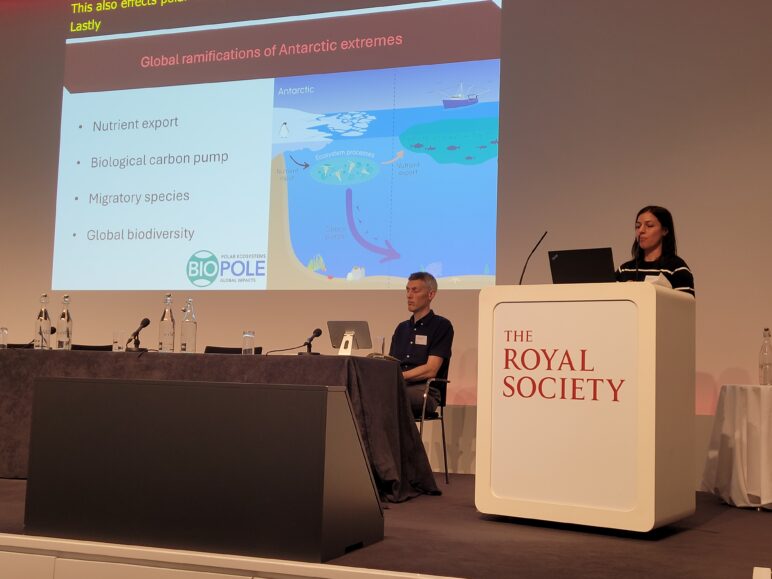
The past few years have witnessed unprecedented extremes in the Antarctic linked to climate change. There’s been exceptionally low winter sea ice and accelerated melting of ice sheets and ice shelves. Atmospheric rivers move heat and moisture poleward under becoming more frequent and are associated with extreme atmospheric warming events precipitation events over Antarctica, both impacting ice mass loss. Low sea ice and atmospheric and marine heat waves have severe knock-on effects for ecosystems. In the context of these threats and concerns, scientists from the British Antarctic survey organised a two-day meeting at The Royal Society, in the historic setting of their London headquarters, to bring together international experts to discuss the state of play in our understanding of Antarctic extreme events, future predictions, and policy and societal relevance.
Throughout the discussions there were some key overarching themes that emerged, cutting across disciplines and other ‘silos’. Timescales as a topic came up as a frequent discussion point, emphasising the links between extreme weather, extreme climate, and abrupt climatic change: events on the timescales of hours or days can impact Antarctic regions for months or even years. It is becoming clear that different components of the Antarctic system experience preconditioning as result of climate change, upon which abrupt change can be triggered by an extreme event. Furthermore, many of these components experience complex interactions of driving and compounding mechanisms. The extent to which extreme events in Antarctica represent irreversible ‘tipping points’, where the climate system shifts into a whole new state, is still a matter of debate.
Another recurring theme was the fact that the observation record is not only too short to understand extreme events in the context of long-term variability, but also Antarctic and Southern Ocean data are scarce both in time and space. There was a call for more multidisciplinary observations, incorporation of existing technologies in Antarctica and the Southern Ocean, and enhanced use of emerging and novel technologies. In addition to recent observations, there was a session that explored the use of the paleoclimate record as a source of analogues to understand what is possible in terms of abrupt Antarctic climate change.
However, we need more than observations: we need a better mechanistic of underlying processes to forecast future events robustly. Predicting the occurrence of extreme events in Antarctica is highly challenging. In addition to the scarcity of observations needed to test models, the interactions between the climate components are highly complex, exhibit non-linear ‘threshold’ behaviour, and highly dependent on choices relating to model scaling and other parameterisations. The proximity of thresholds, reversibility of climate change, and the amplification by suddenly extreme events all remain unclear. What is clear is that the drivers of extreme events will get stronger with every increment of warming.
The final two sessions focused on the policy relevance both regionally and globally of extreme events in Antarctica. Close to home, given Antarctica is one of the dominant sources of uncertainty in sea level change projections, there’s a clear and pressing need to understand the full range of possible Antarctic melt outcomes for UK infrastructure and its population. A key message was that communication and translation of science is critical, and we all have a responsibility to make sure the science knowledge is available to the stakeholders that need it, and to work towards inclusive career development for a diverse future scientific community.
Kate Hendry is an ocean scientist at the British Antarctic Survey, and lead organiser for the Royal Society Discussion Meeting “Global impacts of climate extremes in the polar regions: is Antarctica reaching a tipping point?”.
The outputs from this row society meeting will be brought together in a special theme issue of the philosophical transactions of the Royal Society A.
The author of this article Kate Hendry (British Antarctic Survey)