
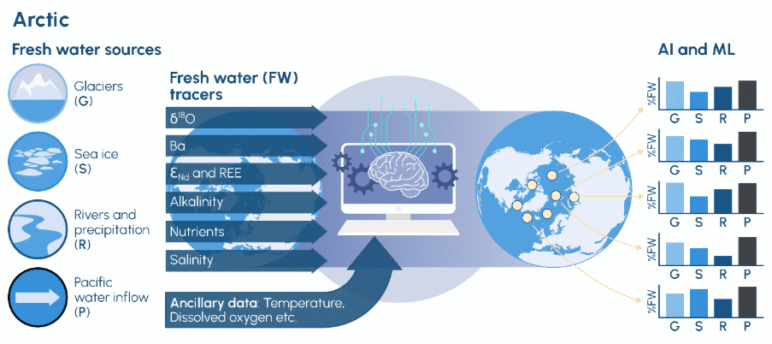
On 1st October, Project AISIT (AI for Stable Isotope Tracers) got underway to help increase our understanding of Arctic freshwater inputs. What AISIT will undertake is the generation of a standardised, machine-readable database of Arctic freshwater tracers and related environmental data. It will bring together data on stable oxygen isotopes (e.g. δ18O), other freshwater tracers like barium, and key nutrient data. By harmonising these data, AISIT will make Arctic freshwater data easier to access, compare, and use. Furthermore, AISIT will engage with the AI community to bench-test the database for further AI research. The project will initially focus on the freshwater tracer and associated environmental data collected by BIOPOLE, before expanding to integrate datasets from the other data sources.
AISIT is funded by a combination of the EPSRC and NERC as part of an ‘AI for science’ call. PI for AISIT, Geraint Tarling, said “AISIT is a great opportunity to bring together key datasets generated by BIOPOLE researchers and combine them with other disparate data that are out there to consolidate what presently exists on Arctic freshwater tracers”. Lead AISIT researcher, Emily Rowlands, added “What is also exciting is the involvement of the AI research community to gain further insights into the relative importance of freshwater inputs to nutrient distributions across the Arctic and beyond”.
AISIT brings together researchers from BAS, NOC and UKCEH to work on this 6-month project. The first few months will mainly focus on data consolidation and quality control before wider interactions with AI researchers. AISIT data-manager, Charles Thorpe-Morgan said “There is a large amount of data out there, but it all needs careful processing to ensure the database meets the highest standards and is fit for purpose”. AISIT work-package leader, Petra ten Hoopen, said “We are writing to as many data holders as we can to emphasise the mutual benefit of sharing data to make the AISIT database as comprehensive as it can be. We assure all potential data providers that database will adhere to FAIR principles (Findable, Accessible, Interoperable, Reusable), where the original sources will be clearly identified and all data contributors will be credited in the database DOI and further citations”
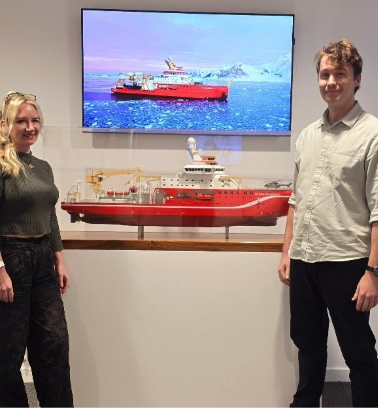
Image: AISIT scientists Emily Rowlands and Charles Thorpe-Morgan, based at the British Antarctic Survey
The Author of this Article Geraint Tarling (British Antarctic Survey)