
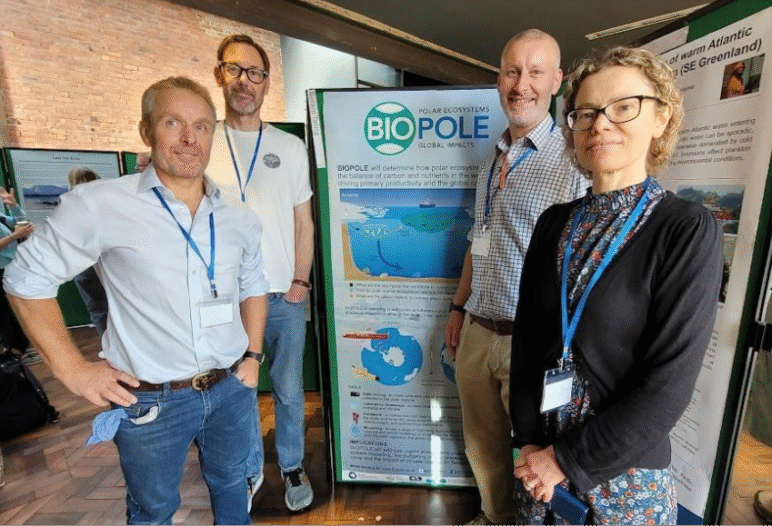
BIOPOLE researchers Kate Hendry, Geraint Tarling, Adrian Martin and Dan Mayor attended the UK Arctic Science Conference, held at Northumbria University in September 2025. The BIOPOLE attendees presented posters on their work on Davis Strait nutrient pathways (Adrian), glacial flour as a source of nutrients (Kate), stable isotope approaches to pelagic species interactions (Dan), and pelagic species complexes in East Greenland (Geraint). The BIOPOLE overview poster was also displayed.
The conference itself brought together leading researchers to examine the nation’s role in Arctic science at a time of accelerating environmental change. It took a rather unique approach in focussing most of the plenary time on discussions addressing (1) Strengths of UK Arctic Science encompassing building on current & emerging strengths and reflecting on UK leadership in Arctic science agendas and (2) Challenges & Building Resilience covering personal, organisational change for more sustainable practice, building sustainable relationships and networks, and the future of Arctic field research. Discussions emphasised the global urgency of Arctic research, with climate-driven transformations—such as sea ice loss, permafrost thaw, and ecosystem shifts—posing risks to infrastructure, security, and international stability. Delegates stressed the need for robust data integration and explored the geopolitical implications of Arctic science partnerships. The BIOPOLE attendees did a good job at representing the programme within such interesting discussions.
Overall, key recommendations from the conference included establishing a centralised Arctic hub, reforming funding models to enable equitable partnerships, and developing a proactive strategy for an ice-free Arctic. The conference concluded with a clear message: UK Arctic science must combine technological excellence with ethical responsibility to maintain leadership in a rapidly changing region – something very much endorsed by BIOPOLE.
The Author of this Article Geraint Tarling (British Antarctic Survey)