
Kate Hendry (BAS) worked with ScienceVega to produce an online article aimed at secondary school students on a recent paper, partnered with BIOPOLE: “Dynamic ice–ocean pathways along the Transpolar Drift amplify the dispersal of Siberian matter”, led by Georgi Laukert at the University of Bristol and published in Nature Communications. The paper was part of the Multidisciplinary drifting Observatory for the Study of Arctic Climate (MOSAiC) project, and investigated the use of chemical tracers for understanding the provenance of freshwater in the ocean and sea-ice in the Arctic.
As the ScienceVega reporter says: “The findings raise fresh concerns about the increasing spread of pollutants and the potential consequences for fragile polar ecosystems as climate change accelerates. The international research provides the clearest ever picture of how the underlying transport system, known as the Transpolar Drift, operates.”
ScienceVega (https://sciencevega.com/) is an organisation that tells stories from scientists to inspire the next generation of scientists, especially encouraging the take-up of STEM subject by girls and a love of science to promote positive mental health in young people.
ScienceVega: What is the Transpolar Drift?
The Transpolar Drift is a big ocean current that cuts right across the middle of the Arctic Ocean, past Greenland and Iceland, and into the North Atlantic. We’re interested in it for lots of reasons, but importantly because it takes a lot of the freshwater from the big Arctic rivers from the Arctic into the Atlantic, where it plays an important role in controlling how the rest of the global ocean moves around (and, so, how the ocean moves heat and carbon around the planet).
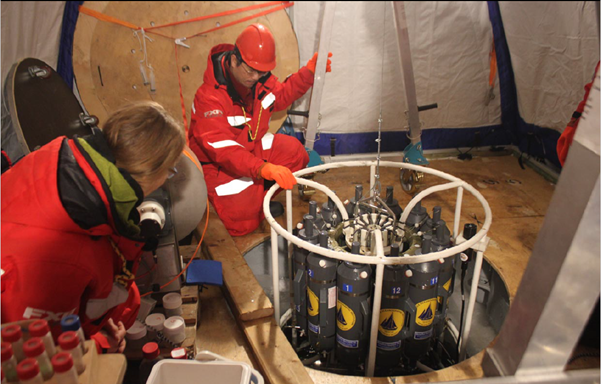
Cover Image: Scientists retrieving seawater from different depths using a carousel water sampler deployed through a hole in the sea ice, sciencevega pg.07
Reference: Laukert, G., Bauch, D., Rabe, B.,… Hendry K.R. & Kienast, S.S. 2025. Dynamic ice–ocean pathways along the Transpolar Drift amplify the dispersal of Siberian matter. Nature Communications, 16(1), p.3172.
The Author of this Article Kate Hendry (British Antarctic Survey)