
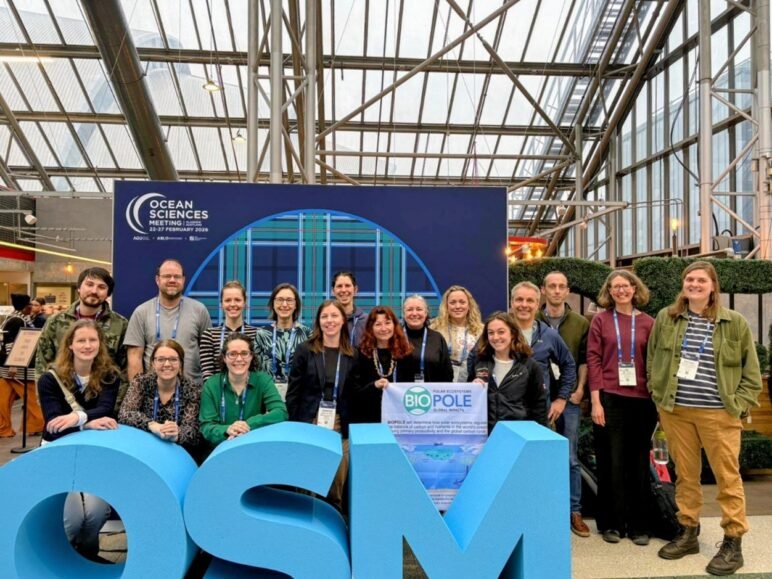
The biennial Ocean Sciences Meeting co-sponsored by AGU, TOS and ASLO, is invariably held in the USA. Imagine our delight then, when it was announced that the 2026 meeting was to be held in our favourite Scottish city – Glasgow (sorry Edinburgh CEH folks!). BIOPOLE members jumped at the chance to attend and present their research at one of the biggest gatherings of ocean scientists and professionals.
For many of us, this was one of the largest and busiest conferences we had attended with well over 5000 delegates from around the world. The conference lasted five days, each with 20+ parallel sessions, keynotes, dozens of exhibits and hundreds of posters to browse. BIOPOLE was represented in many of these; members from WP1&2 co-convened a session on “Pelagic and Coastal Nutrient Cycles in Changing Polar Marine Ecosystem”. Similarly, some WP3 co-convened a session on “Modelling Biophysical Interactions in the Polar Oceans Across Spatial Scales: Ocean–Sea Ice Dynamics, Climate Sensitivity, and Ecosystem Response”. Others presented their work on phytoplankton, copepod observations, and modelling advances in both oral and poster presentation formats. In total we presented 11 BIOPOLE talks and 13 posters. Moreover, we were delighted to be joined by many of the early career scientists that have participated in BIOPOLE-led cruises and land-based field campaigns. It was great to see their results from these campaigns and to catch up over dinner and drinks in the evenings.
Overall, Ocean Sciences was busy and productive! It was wonderful to see and take part in many discussions covering the whole breadth of BIOPOLE’s science, to strengthen connections and make new ones, and to come home with brains full of new ideas and renewed motivation.
Following the Ocean Sciences Meeting and staying in Glasgow, several BIOPOLE researchers joined a group of around 100 oceanographers to participate in a three-day workshop organised by the Bio-Carbon project and hosted by the University of Strathclyde’s Technology and Innovation Centre. The workshop objective was to draw on expert opinion to specify the most important processes related to oceanic biological carbon fluxes, rank those processes in order of their probable magnitudes at global scale, and ascribe a measure of readiness for incorporating the process into oceanographic models. The aim of the game was to inform the next generation of global ocean models. The workshop split into eight discussion groups, each with a separate theme related to carbon fluxes, and tasked with specifying and ranking the most important processes within the theme. Particularly relevant to BIOPOLE were discussions on zooplankton processes and active flux via animal migrations. After much deliberation, it was (pretty-much) agreed that zooplankton diel vertical migration is, globally, more significant than seasonal migrations, and that DVM is closer to being readily incorporated into oceanographic models. Asides from the discussion groups, the workshop involved regular plenary talks to keep everyone updated and on-track, a poster session, and, of course, much mingling. To conclude the workshop, the discussion coordinators presented their agreed-upon list of critical biological carbon flux processes, and committed to writing a white paper detailing those findings to motivate and steer further development of ocean models to represent what we agreed are the critical but as yet unresolved processes.
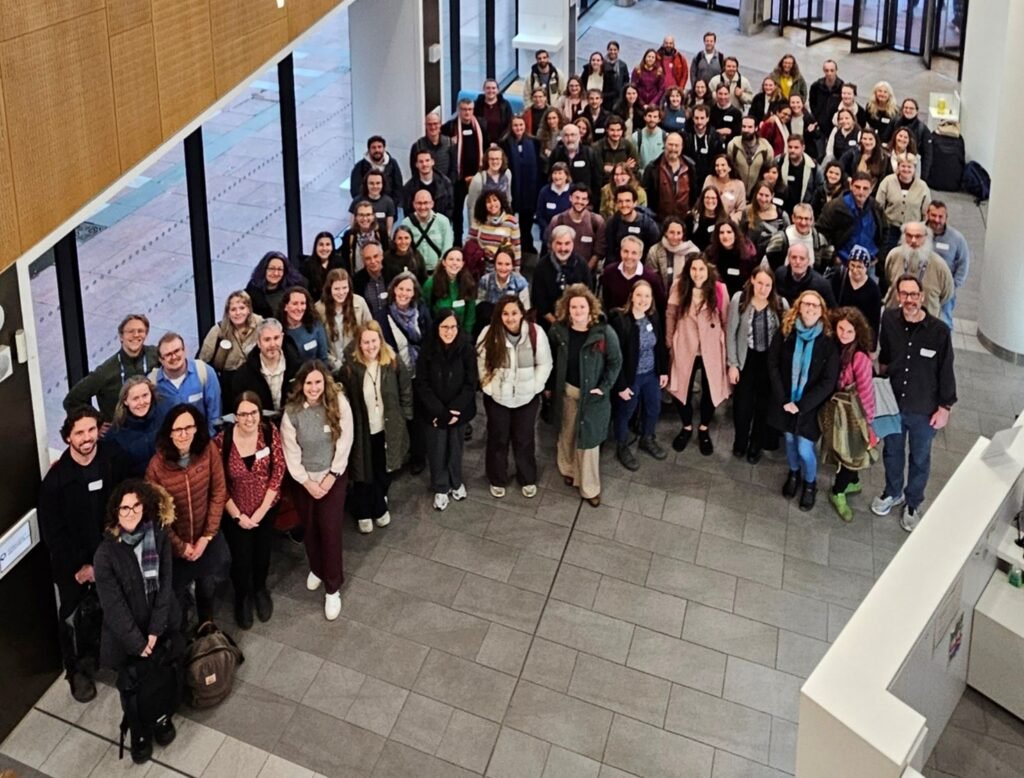
BIOCARBON participants © A. Martin
The Author of this Article Jennifer Freer (British Antarctic Survey) and Aidan Hunter (British Antarctic Survey)