
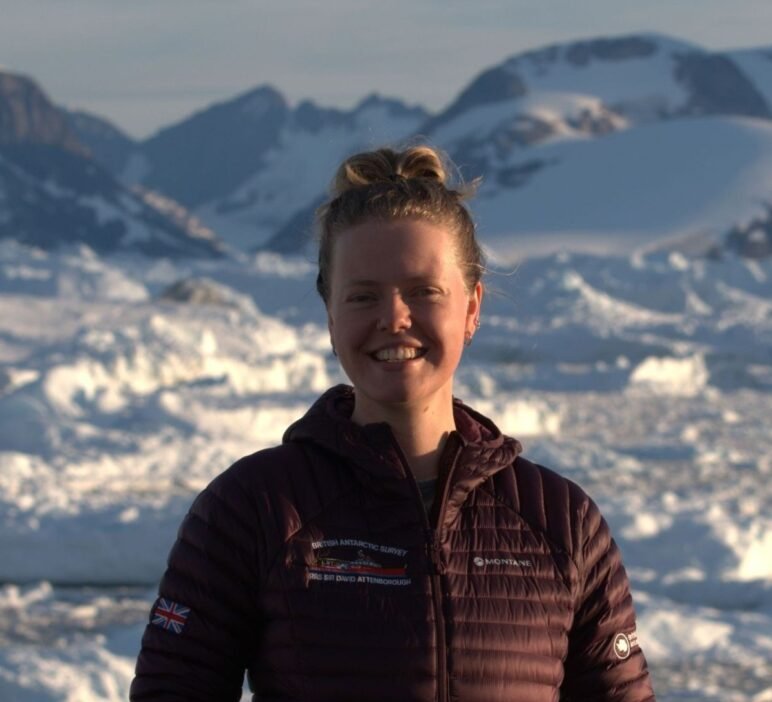
Rhiannon Jones
- Please introduce yourself.
Hello! I’m Rhiannon Jones, a postdoc at BAS, working on the Si-CLING project (linked with BIOPOLE WP1).
- Tell us about your professional and academic career before becoming part of the BIOPOLE Community.
My primary academic focus is understanding the role that glaciers play in marine biogeochemical cycles. Throughout Earth’s history, we think that glaciers have played a key role in modulating primary productivity in the oceans (i.e. the growth of phytoplankton) and therefore the marine carbon cycle. As glaciers melt, this melt is transported into the ocean, carrying vast quantities of terrestrial sediment, rich in elements like iron and silicon that are essential nutrients for the growth of phytoplankton (marine algae). Before joining BAS, I was doing my PhD at the University of Southampton, using a range of isotope and x-ray microscopy techniques to better understand how bioavailable (easy to consume) the iron delivered by glaciers is to phytoplankton, and how far it is transported in the ocean, beyond the glacial environment.
- What do you do within BIOPOLE?
Within BIOPOLE, I am working on the Si-CLING project. This project, led by Prof. Kate Hendry and in collaboration with the University of Cambridge, seeks to further our understanding of the role that glaciers play in delivering bioavailable (there’s that word again) silicon and iron to the high latitude regions. Si-CLING has done fieldwork in Svalbard, Greenland, Patagonia, Iceland, and the West Antarctic Peninsula! I was fortunate to go to Ryder Bay (West Antarctic Peninsula) during the Antarctic winter, to try and determine the seasonality of glacier and fjord biogeochemical cycles. One technique we use in Si-CLING is high-resolution inductively-coupled-plasma mass spectroscopy to measure the ratio of different silicon isotopes in samples. This highly precise technique measures tiny differences in mass on the atomic scale! This helps us figure out where that silicon atom came from – and we can then link this to how bioavailable it is.
- What have you enjoyed about BIOPOLE so far?
Getting out in the field is one of the best parts of the job. We got to do fieldwork in Antarctica in winter (June 2025). There were days the sun did not rise, and one evening we watched a glacier calve huge chunks of ice in total darkness! The ship lights lit up the collapse. That was a once in a lifetime experience.
- Tell us about a skill or trait unique to you that you would like to share?
Working with seawater and sediments requires a large range of geochemical skills. I can go from slicing >10 m long sediment cores head-to-toe covered in mud, to using a synchrotron particle accelerator to determine the coordination environment of inner electron shells in atoms of iron (that’s nanometer scale!).