
On 9th April, 2026, the Artificial Intelligence for Stable Isotope Tracers (AISIT) programme held its end of programme meeting to assess its final outputs and scientific legacy. The programme had started just 6 months earlier from a comparatively short lead in time since writing the proposal. The AISIT programme was addressing the objectives of an EPSRC/NERC call “AI for Science” to prepare databases and systems to make environmental data more accessible to AI analysis. The idea was to amass as much Arctic freshwater tracer data as possible, including that generated BIOPOLE, into an AI-friendly database. AISIT scientists would also test the database themselves through using it in their own scientific analyses. With just 6 months to get through its ambitious targets, it was a race to the finish.
A major focus of BIOPOLE is the consequences of warming to the polar regions, which leads to a significant increase in glacial meltwater discharge, large alterations in major Arctic river outputs and unprecedented levels of sea-ice retreat, of which all can alter the amount and the distribution of nutrients in the global ocean. Different sources of freshwater inputs (rivers, glaciers, and sea-ice), can be tracked through tracers such as the stable oxygen isotope δ¹⁸O, as well as certain trace metals and Rare Earth Elements. Freshwater tracer measurements are particularly insightful when combined with accompanying salinity measurements as well as temperature. Application of AI and ML on such data has the potential to identify patterns and cyclicities in the input and movement of freshwater in the Arctic that can complement the more mechanistic analytical and modelling approaches traditionally used by marine scientists.
Over its 6 months, AISIT achieved the following: (1) a comprehensive compilation Arctic data entries for δ¹⁸O (and dissolved Barium) from all available research-grade open data sources, including any unpublished data where viable; (2) the inclusion of ancillary in situ environmental data, especially salinity, temperature and depth, and spatio-temporal information on data collection; (3) quality-control with flags and detailed documentation to guide non-domain experts in its use; (4) open access publication of the database, following the FAIR data management principles. The data can be accessed through a dedicated website (http://www.aisit.ac.ukwww.aisit.ac.uk) as well as from the Polar Data Centre (https://www.bas.ac.uk/data/polar-data-centre/).
The further value of the AISIT database was training AI and ML methods to examine patterns and trends in environmental data. To this end, AISIT benefited from being able to bring together AI/ML practitioners and non-AI polar and marine science specialists. A major focus was to identify AI/ML challenges to best utilise the AISIT database. As a benchmark, we used a neural network approach to reconstruct the δ¹⁸O distribution and generate Arctic wide maps with a temporal dimension. This approach provided certain performance metrics, such as the capacity to simulate the influence of the climatic Arctic Ocean Oscillation on freshwater inputs and water movements. This has now provided the basis for potential AI challenges, to find ways of gridding the freshwater tracer data in space and time and better reveal underlying climatic oscillations. The challenges are designed to be compatible with platforms such as Kaggle and hackathons to develop analytical Notebooks.
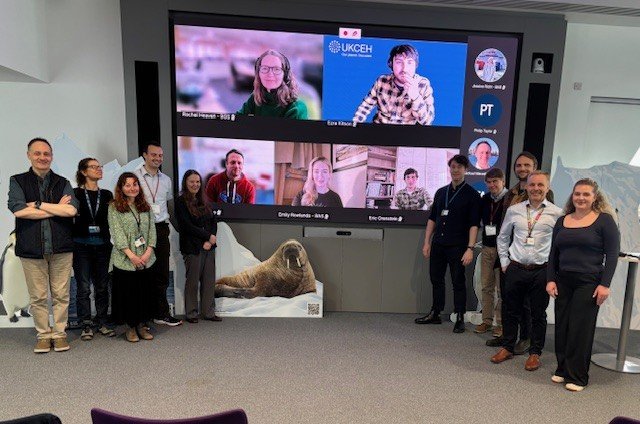
During our end of programme meeting, the AISIT team brought together the many different elements of the programme and considered legacy outputs such as a high impact data paper, analytical papers examining features of the Arctic Ocean Oscillation and how to construct AI/ML challenges. As evident from the smiles in the picture below, the team were very pleased to have contributed to such a successful and impactful programme.
Featured Image: AISIT team at our final meeting April 9th 2026
In person (left to right): Mike Meredith (BAS), Kate Hendry (BAS), Petra Ten Hoopen (BAS), Jonathan Coney (NOC), Helen Peat (BAS), Charles Thorpe-Morgan (BAS), Yevgeny Aksenov (NOC), Ben Evans (BAS), Geraint Tarling (BAS), Jessica Richt (BAS)
Online: top left: Rachel Heavens (BGS, “High5 for AI” project); top right: Ezra Kitson (UKCEH); bottom, left to right: Tom Prime (NOC), Emily Rowlands (BAS), Eric Orenstein (NOC)
Not in picture: Adrian Martin (NOC), Bryan Spears (UKCEH), Archie Cable (NOC), Pilvi Saarikoski (BAS)
The Author of this Article Geraint Tarling (British Antarctic Survey)