
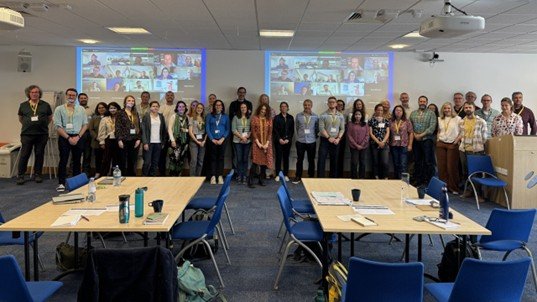
Although the UK is not an Arctic state, it has strong and long-standing connections to the Arctic region. Changes in the Arctic Ocean are already affecting the UK through global sea-level rise, shifts in climate and weather patterns, and impacts on ecosystem services. Recognising this importance, the National Oceanography Centre (NOC) hosted a workshop in June 2025 on the contribution of UK Arctic Ocean science to the 5th International Polar Year (IPY 2032/33).
The workshop aimed to identify priority Arctic research questions for the coming years and to highlight the unique strengths and technologies the UK can offer the international community. More than 50 scientists from 26 higher-education, research, and non-profit organisations took part over one and a half days, both in person and online. BIOPOLE was well represented by Geraint Tarling, Clara Manno, Adrian Martin, Stefanie Rynders, Yevgeny Aksenov, Peter Brown, Dan Mayor, Mar Benavides, and Elena Garcia-Martin.
The meeting opened with presentations from James Jansen (FCDO) and Henry Burgess (NERC Arctic Office), who highlighted the importance of UK Arctic science and outlined the 5th International Polar Year. Jeremy Wilkinson (BAS) then reviewed existing international Arctic observing networks, followed by a joint presentation from Matt Spencer and Ale Vergara-Peña (WWF-UK) on the WWF Global Arctic Programme. Jessica Surma (UKRI) concluded the session with an overview of current NERC funding for Arctic research.
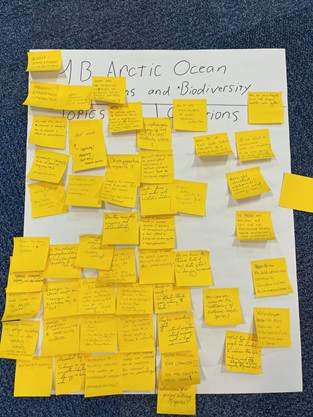
Participants then discussed six high-level research themes, including Arctic Ocean climate, ecosystems and biodiversity, global impacts, hazards and resilience, human impacts, and socio-economic change. These sessions were highly interactive, with colourful yellow post it notes rapidly filling the theme charts. The brainstorming proved extremely productive, as reflected in the crowded flip charts and lively discussions.
The second day focused on developing the scientific and innovation framework for each priority research question. While much of the document was drafted during the workshop, participants contributed further input afterwards to finalise the report, which is available here.
The Author of this Article Elena García-Martín (National Oceanography centre)