
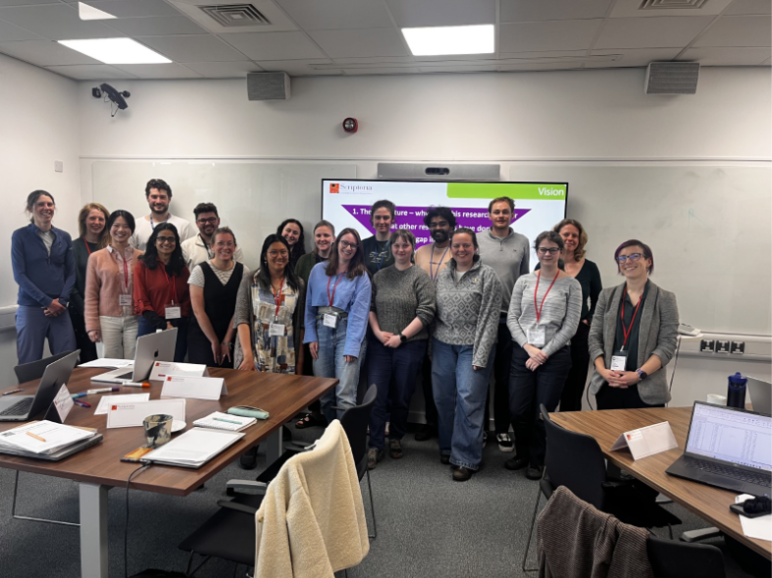
On 7-8 May 2026, the BIOPOLE project hosted a Grant Writing Workshop for Early Career Researchers (ECRs) from BIOPOLE, other National Capability Long-Term Science Multicentre 2 (NC LTSM 2) projects, and UKRI-BAS. The workshop was delivered by Scriptoria and hosted at UKRI-BAS in Cambridge. It was designed to support ECRs who are planning or actively applying for research funding, helping them to develop strong and competitive fellowship and grant applications. The course was aimed at researchers looking to build their track record and secure funding for independent research through awards, fellowships, and project grants. The workshop was attended by 18 ECRs. Below, one participant reflects on their experience:
‘Just as no one teaches you about taxes when you transition into adulthood, no one teaches you about grant writing when you transition into research. As a new PhD graduate, I only realised now that the nuts and bolts of research funding are treated as an open secret, something you’re supposed to pick up along the way as a PDRA, except that PDRAs rarely get to write grants in the first place. This course cut through all of that and gave us the foundations we should have had from the start.
What I appreciated most about this course was that the leader spared us of the confusion entirely by drawing on real hands-on experience. They broke each stage down into concrete building blocks, making each section of a grant feel learnable rather than like something reserved for those already in the know. Things I once lumped together, aims, objectives, outputs, outcomes, and impacts, suddenly had distinct meanings.
I now have a much clearer sense of how to approach grant writing, and I better understand what my PI and more established colleagues are actually looking for. That means I can contribute meaningfully to the process, rather than just hovering at the edges.
If there is appetite for a follow-up, I would love sessions on where to find relevant grants, how to identify the right collaborators, and how to develop a project idea from the ground up. I suspect the first of those is a course in its own right, and one I would sign up for without hesitation.
I am still confused about my taxes, but at least grant writing is now fully decoded. My biggest takeaway? Ditch the jargon, embrace Gantt chart, and remember that the lay summary might just be the most important part of the grant.’
The authors of the article Ruta Hamilton (British Antarctic Survey) and Print Sakulsupich (Yusuf Hamied Department of Chemistry, University of Cambridge, project – TerraFIRMA)