
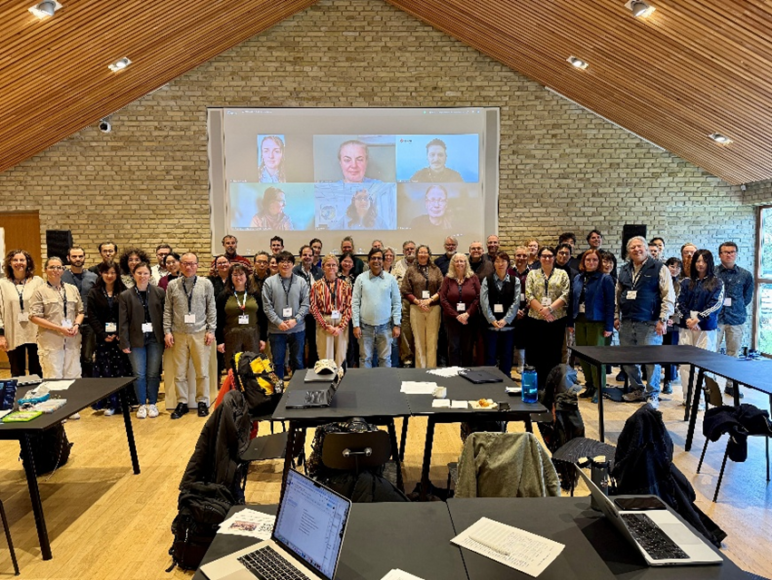
Geraint Tarling has recently become a delegate for the UK on the International Arctic Science Council (IASC) Marine Working Group (MWG). IASC is an independent, non-governmental scientific organisation, which aims to promote and coordinate international Arctic research, including the sharing of facilities and data. It mainly focuses on science but can also provide advice policy makers. A major part of IASC is the working groups, covering disciplines such as atmosphere, cryosphere, marine and social sciences. As a UK delegate, Geraint will attend MWG meetings every 6 months, either in person or on-line. In March, he went to Aarhus University, Denmark where the IASC working groups met as part of the Arctic Science Summit Week. The MWG meeting was filled with updates of Arctic science activities being carried out by a number of nations, including non-Arctic nations such as Turkey and Japan. As a further part of their remit, IASC working groups provide a small amount of funding for fellowships aimed at Early Career Researchers. Reports back from these fellows were a particular highlight, such as that from Japanese ECR, Monica Ogawa, who lived with Inuit in Greenland and recorded previously unobserved behaviours in Narwhals. Geraint made a short report on BIOPOLE and AISIT activities, focussing on the new Arctic delta O18 database. There were reports from other delegates on upcoming major activities, such as the Norwegian multi-billion kroner Arctic Ocean 2050 programme and the EU funded Beyond Arctic Passion programme. Preparing for the next International Polar Year in 2032-2033 was also a major topic of discussion. Overall, the IASC MWG is an important platform in which to make other nations aware of UK science activities and to find out about major national and international Arctic science initiatives where there is the potential to collaborate.
The Author of this Article Geraint Tarling (British Antarctic Survey)